
On a house, a blocked gutter is usually a nuisance. On a mill, a warehouse or a school, it can mean water running down the inside of a wall, soaking stock or closing a room. Commercial gutters are bigger, longer and often harder to see than domestic ones, and they tend to fail in different ways.
This guide is for owners, facilities managers and landlords looking after commercial buildings in and around Huddersfield.
Why commercial gutters fail differently
The basic job is the same: collect rainwater from the roof and carry it away. The difference is scale and design.
Long runs and large roof areas
An industrial unit or office block can send a large volume of water into a single gutter run. If one outlet is partly blocked, the water has nowhere else to go, and a small restriction quickly becomes an overflow in heavy rain.
Valley, box, parapet and internal gutters
Many older commercial buildings, including the converted mills you see around Huddersfield, Elland and Brighouse, have gutters that sit behind parapet walls, in valleys between roof slopes, or inside the building line. These are easy to forget because nobody can see them from the car park. When they overflow, the water often goes inwards rather than over the edge.
Historic England makes the point that with valley, box and parapet gutters, a visual inspection from ground level may not suffice. Someone needs to get up and look.
Outlets and downpipes
The gutter itself may be clear while the outlet or downpipe below it is choked. Leaves, silt and other debris collect at the point where the gutter meets the pipe, and a blocked downpipe can back water up along the whole run.
Leaves, moss and silt
Sites with trees nearby, such as schools, business parks and housing blocks with landscaped grounds, collect a lot of leaf litter in autumn. Moss washes off roof slopes into gutters through the year. On large industrial roofs, fine silt and grit build up gradually and settle in outlets, which is easy to miss until it causes a problem.
What happens when they overflow
The cost of a blocked commercial gutter is rarely the gutter itself. It is what the water does next:
- Water getting into the building through walls, parapets or the junction between the roof and the wall
- Damage to stock, equipment, records or fittings below
- Stained or collapsed ceilings and damp internal walls
- Slip hazards where water spills onto paths, entrances and car parks, which can freeze in winter
- Rooms, classrooms or whole units taken out of use while repairs are made
Insurers take this seriously. Marsh’s guidance on winter risks for commercial property recommends checking gutters and downpipes before and during winter, clearing leaves and debris, and inspecting buildings again after severe weather. It is also worth checking your own policy wording for any maintenance conditions.
A pre-winter gutter checklist
Late autumn, once most leaves are down, is the right time for a proper check. A sensible list includes:
- Clear all gutters, valleys and outlets of leaves, moss, silt and debris
- Check downpipes are running freely, including any internal ones
- Look for sagging sections, joints that have pulled apart and brackets that have worked loose
- Check that gutters still fall towards their outlets and are not holding standing water
- Look at the walls below for staining, green streaks or damp patches that point to past overflows
- Check internal ceilings and walls on the top floor, or below internal gutters, for signs of water
- Note any trees that overhang the roof and may need cutting back
- Record what was found and what was done, with photographs if possible
How often should commercial gutters be checked?
The RICS isurv guidance on roof drainage and guttering says inspections are preferable at least twice a year, and more often where gutters are likely to collect fallen leaves or wind-blown debris. For most commercial buildings, that means a visit in late autumn and another in spring, with extra checks for sites surrounded by trees.
It also makes sense to check again after a storm or a spell of very heavy rain. Wind can shift brackets and joints, and storms bring down debris that blocks outlets. Our post on checking your roof after winter storms covers what to look for afterwards.
Who is responsible?
Responsibility depends on how the building is held and, in let buildings, on the exact wording of the lease. Owner-occupiers carry it themselves. In a single-let building, the lease should say whether the landlord or the tenant is responsible for the roof and rainwater goods. On multi-let sites, the roof and gutters are commonly kept by the landlord or a managing agent, with costs recovered through a service charge, but that isn’t always the case. Leases vary, so this is general guidance rather than legal advice. If the wording isn’t clear, ask your managing agent or a solicitor, and do it before winter rather than after a leak.
Work at height duties
Whoever arranges the work has duties too. The Work at Height Regulations 2005 apply to anyone who controls work at height, and the HSE specifically mentions facilities managers or building owners who may contract others to do it. The work must be properly planned, supervised and carried out by competent people.
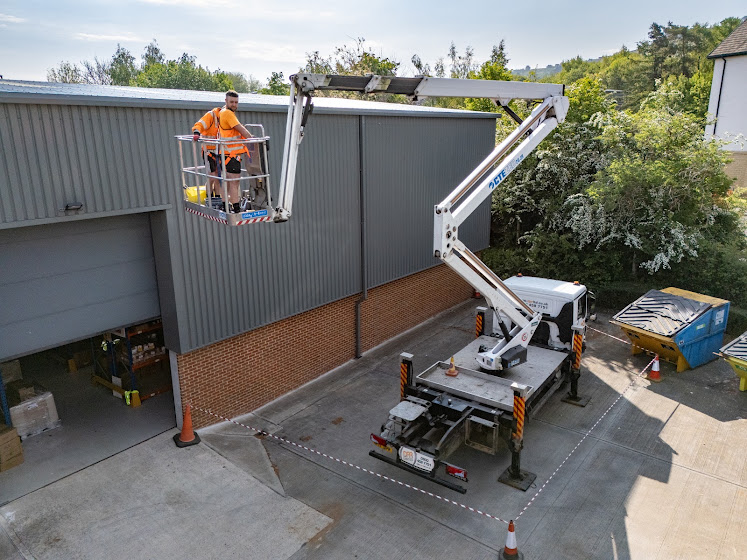
In practice, that means not sending a caretaker up a ladder to scoop out a parapet gutter on a three-storey building. HSE’s step-by-step guide says ladders can be a sensible option for tasks of low risk and short duration, and puts measures that protect everyone, such as mobile elevating work platforms (MEWPs), ahead of personal protection. Clearing long runs of commercial guttering is rarely low risk or short. Historic England also notes that a cherry picker may be needed to reach high-level gutters safely.
A MEWP lets the operative work from a guarded platform, move along the gutter run, and see into valleys and box gutters that cannot be checked from the ground. DPR uses a two-man powered access boom on a slim-line vehicle mount for this kind of work, which can get into tighter spaces than larger machines. You can read more on our high level access page.
Planned maintenance or reactive call-outs?
Calling someone out once water is already coming in means paying for the repair, the internal damage and the disruption, often in the worst weather.
Planned maintenance means gutters are cleared and checked on a schedule, problems such as loose joints or poor alignment are picked up early, and you have a record to show your insurer. For buildings with lots of trees nearby or hidden gutters, it is usually the better option. DPR carries out commercial gutter repairs, re-alignments, clearance and cleaning, and removes debris on a contracted basis as well as for one-off jobs.
Gutter problems are sometimes a sign of something else on the roof, such as a failing flat roof or a damaged valley. If that is the case, our commercial roof repair team can look at the wider picture.
What to ask a gutter contractor
Before you appoint anyone, it is worth asking:
- How will you access the gutters, and what equipment will you use?
- Can you provide a risk assessment and method statement for the work?
- Are your operatives trained for the access equipment they will use?
- What insurance do you hold?
- Will you check outlets and downpipes as well as the gutters?
- Will you report what you found, including any repairs needed, with photographs?
- Can you carry out repairs and re-alignments, or only cleaning?
- Can the work be set up as a regular contract, with visits timed for autumn and spring?
Get your commercial gutters ready for winter
DPR Roofing is a family-run business and has been roofing since 1989. We clear, clean, repair and re-align gutters on commercial buildings across Huddersfield and the surrounding area, using our own powered access boom where it is needed. Find out more about our gutter clearance, repair and renewal work, or get in touch or call 01484 866 772 to arrange a pre-winter check.